Artificial intelligence is changing how businesses build applications, analyse information and deliver digital services. From generative AI and recommendation engines to computer vision and advanced analytics, organisations across industries are running workloads that require significantly more computing power than traditional applications.
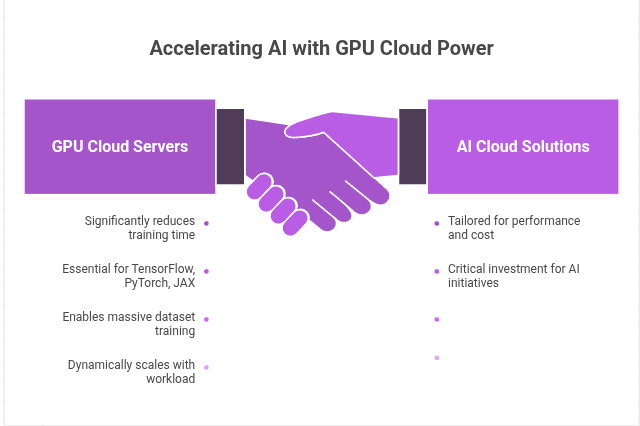
Graphics processing units (GPUs) have become central to this transformation because they can perform the parallel computations required by many AI and machine learning workloads. However, deploying and managing GPU infrastructure can be challenging. Businesses need access to high-performance hardware while avoiding unnecessary infrastructure costs and ensuring that computing capacity is available when workloads demand it.
This is driving interest in more flexible approaches to GPU infrastructure, including on-demand and serverless models.
Why GPUs Matter for Modern AI
Traditional CPUs are designed to handle a broad range of computing tasks, making them suitable for everyday enterprise applications. GPUs, on the other hand, can process many calculations simultaneously, making them particularly effective for AI model training, inference and other highly parallel workloads.
As organisations adopt larger AI models, their requirements for GPU capacity are increasing. Training a model can require substantial computing resources for extended periods, while inference workloads may experience sudden spikes in demand.
The Limitations of Dedicated GPU Infrastructure
Businesses can purchase or reserve dedicated GPU servers to support AI applications. This approach can provide predictable performance and greater control, but it can also involve significant capital expenditure.
GPU hardware is expensive, and organisations need additional infrastructure for power, cooling, networking, storage and physical space. There is also the challenge of utilisation. A business may need substantial GPU capacity during a model-training project but considerably less once training is complete.
Unused GPU capacity represents an inefficient allocation of resources. This is particularly relevant for organisations whose AI workloads fluctuate throughout the day or change as projects progress.
As a result, businesses are looking for infrastructure models that provide access to GPU computing without requiring them to continuously maintain large amounts of dedicated capacity.
Understanding the Serverless GPU Model
A serverless GPU approach allows developers and businesses to access GPU resources when they need them without managing the underlying physical infrastructure themselves.
The concept builds on the principles of serverless computing, where users focus on applications and workloads while the infrastructure provider handles provisioning and resource management.
With serverless GPU infrastructure, GPU resources can be allocated dynamically based on workload requirements. When an AI application needs additional computing capacity, resources can be provisioned. When demand falls, capacity can be released.
This model can be particularly useful for workloads such as AI inference, image generation, model experimentation and batch processing, where computing requirements can vary significantly.
Improving Resource Utilisation
One of the key benefits of flexible GPU infrastructure is improved resource utilisation. Instead of maintaining GPUs that remain idle between workloads, organisations can align computing capacity more closely with actual demand.
For example, a business developing an AI-powered application may require GPUs during testing and model inference. Rather than purchasing enough hardware to accommodate peak requirements, it could use on-demand resources and scale capacity according to application usage.
This can help businesses manage infrastructure costs while still providing access to high-performance computing when required.
The Role of Cloud Infrastructure
Cloud platforms have played an important role in making flexible computing models accessible to businesses. Cloud computing services allow organisations to provision infrastructure based on their requirements rather than maintaining all computing resources on-premises.
For AI workloads, this can include access to GPU instances, storage, networking and other infrastructure components. Organisations can also combine cloud resources with their existing data centre infrastructure to create a hybrid environment.
However, businesses should evaluate cloud-based GPU infrastructure carefully. Factors such as GPU availability, workload performance, data transfer costs, security requirements and geographic location can influence the overall economics of a deployment.
Supporting AI Development and Inference
GPU infrastructure is required for different stages of the AI lifecycle. During development, data scientists may need GPUs to train and fine-tune models. Once a model is deployed, GPUs may be required to process user requests and generate predictions or responses.
These workloads have different infrastructure characteristics.
Training can involve sustained, high-intensity GPU usage, while inference can be highly variable. An application could receive thousands of requests at one time and very few at another.
Flexible GPU infrastructure can therefore be particularly valuable for inference workloads, allowing businesses to scale resources as application demand changes.
The Future of GPU Computing
As AI becomes part of more business applications, access to computing resources will become an increasingly important consideration. Organisations will need infrastructure that can support growing AI workloads without forcing them to overprovision capacity.
Flexible GPU models can help address this challenge by making high-performance computing more accessible and responsive to demand.
The broader shift is toward infrastructure that works in the background while developers and businesses focus on applications and outcomes. Whether organisations use dedicated servers, cloud-based GPUs, or serverless models, the goal remains the same: provide the computing performance required by AI while using resources efficiently.
As AI adoption expands, businesses that build flexible and scalable computing strategies will be better positioned to experiment, deploy and scale AI applications without allowing infrastructure limitations to become a barrier to innovation.